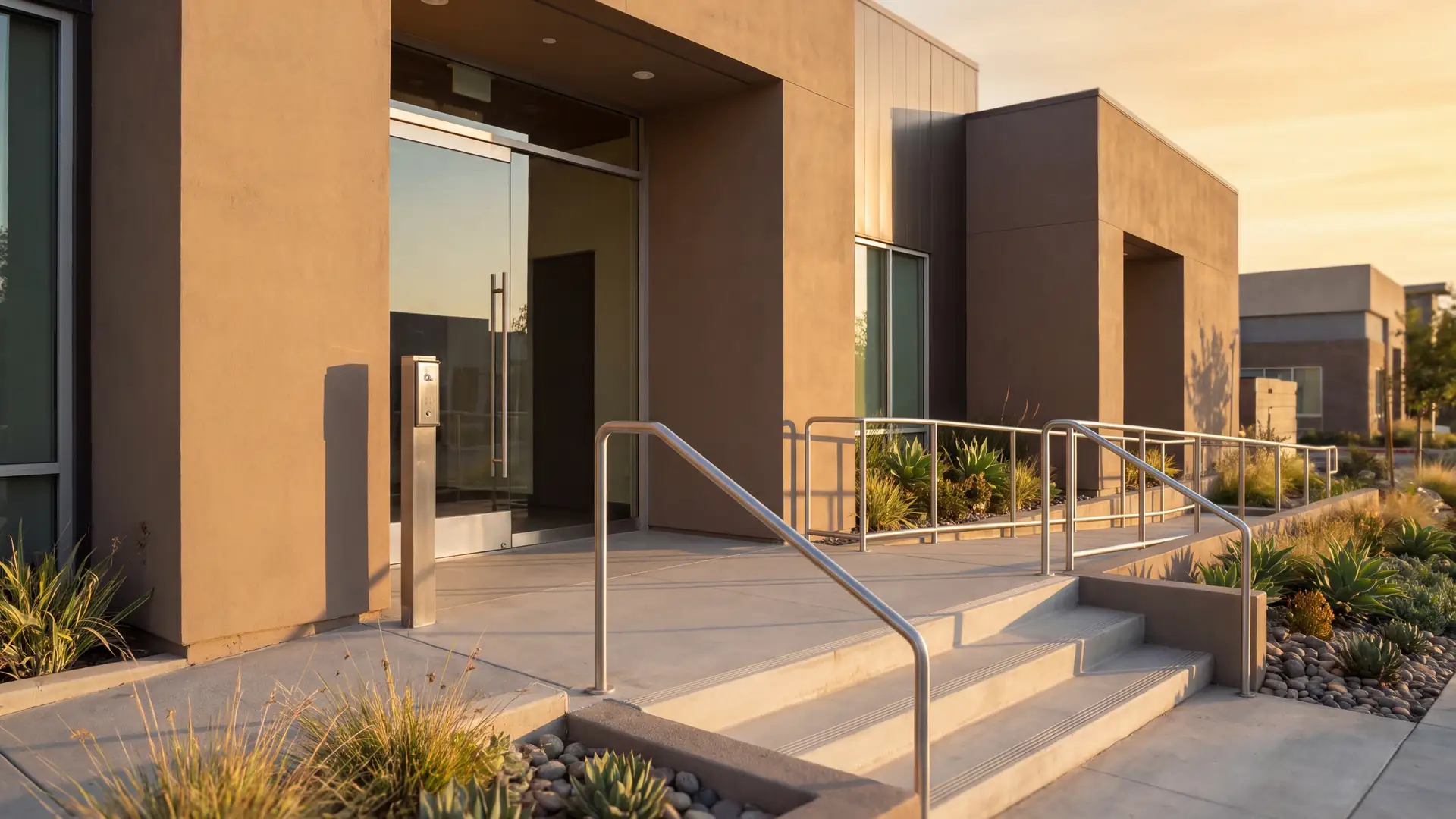
ADA and accessibility
upgrades in
San Diego.
Kaminskiy Commercial Construction builds accessibility upgrades for commercial buildings across San Diego County: parking, ramps, entrances, counters and restrooms. We build to the federal ADA standards and the California Building Code, from a Certified Access Specialist's report or as part of a remodel, with the drawings and the permit on one contract.
- What we buildParking, routes, entrances, restrooms
- WhereSan Diego County
- LicenseCSLB B General Building #922807
- How we workDesign, permit and construction, one contract
Accessibility upgrades
Two rule books apply to every commercial building in California, and the stricter one wins.
The federal Americans with Disabilities Act sets one standard. Chapter 11B of the California Building Code sets another, and where they differ California's is usually the stricter. A building has to meet both.
We are builders, not inspectors or lawyers. A Certified Access Specialist inspects and reports. We draw, permit and build what the report calls for.
The route, in numbers
An accessible route is measured, not judged.
Six of the figures a route is checked against, from the parking space to the restroom.
- 1:12
Ramp slope
The steepest a ramp may be: one inch of rise for every twelve inches of run.
- 48 in
Walkway width
The least width of an exterior walk in California.
- 32 in
Doorway
The least clear opening of a door, measured with the door open.
- 5 lb
Door force
The most push or pull an interior door may need in California.
- 34 in
Counter height
The greatest height of the accessible part of a sales or service counter in California.
- 60 in
Turning space
The diameter of the clear circle a wheelchair needs to turn, in a restroom for example.
These are common figures from the California Building Code. A real project is measured against the full standard, which has many more.
When it comes up
Four things that start an upgrade.
Few owners begin with accessibility. It arrives attached to something else.
- 01
A remodel or a tenant improvement
Altering a commercial space also means making the path to it accessible. In 2026, where the construction cost is $209,208 or less, the code caps that added work at 20 percent of the cost. Above that amount the path has to comply in full. The state resets the figure every January.
- 02
A CASp report
An owner or a tenant orders an inspection, and the report lists what does not comply. The list becomes the scope of work.
- 03
A complaint or a demand letter
An owner who receives one should speak with an attorney first. We build the corrections that follow.
- 04
A new lease or a sale
California requires a commercial lease to state whether the space has had a CASp inspection, so inspections are often ordered when a space changes hands.
The work
What usually gets fixed.
From the car to the sink, in the order a visitor meets them.
How the rule works on a build-out is on the tenant improvement page. Six San Diego rules.
Parking
The accessible and van spaces, their access aisles, slopes, striping and signs.
The route in
Curb ramps, walkways and slopes between the parking, the sidewalk and the door.
The entrance
The landing, the threshold, the door's width, its hardware and the force it takes to open.
Counters
A lowered section at reception, sales and service counters.
Restrooms
Clearances, grab bars, the height of the sink and the toilet, accessories and the door.
Signs
Raised-letter and Braille signs at rooms and restrooms, and signs along the accessible route.
Questions
Accessibility upgrade questions.
What is a CASp inspection?
A CASp is a Certified Access Specialist, a person certified by the State of California to inspect buildings against the accessibility standards. The inspection produces a written report of what complies and what does not. We do not perform CASp inspections. We build the corrections a report lists.
Do older buildings have to comply?
In part. Federal law has no blanket exemption for older buildings: owners are expected to remove barriers where that can be done without much difficulty or expense. And any remodel brings the remodeled area, and the path to it, under the current building code.
Does a remodel mean upgrading the whole building?
No. The California Building Code requires the remodeled area to comply, and the path of travel to it: the parking, the route, the entrance, and the restrooms, drinking fountains and signs that serve it. On smaller projects the code caps that added work at 20 percent of the construction cost.
Who pays for accessibility upgrades, the landlord or the tenant?
The lease decides who pays. Federal law can hold both the landlord and the tenant responsible to the public, so the lease should say it clearly. California also requires a commercial lease to state whether the space has had a CASp inspection.
Do accessibility upgrades need a permit?
Most do. Ramps, restroom changes and changed doors are permitted work. Signs and re-striping often are not. The building department that has the address decides.
Start here
Request a site walk in San Diego County.
Tell us about the space. We will call to set a time to walk it with you.
Office12396 World Trade Dr, Suite 106A
San Diego, CA 92128
Phone(858) 371-3839
HoursMonday to Friday, 8:00 AM to 4:30 PM